

- Heroism and History Lessons: Two Centuries of Irish Rebel Music


Heroism and History Lessons: Two Centuries of Irish Rebel Music
By Taylor Youngling
Published September 25, 2026
“We seek what our fathers were robbed of…on the altar of Ireland we’ve pledged our devotion and sworn that as slaves we’ll be ruled…no more!…Blest be each name that the holy war wages! Who could the shrine of his country profane?” These are a few lines from the verses of Gerald O’Brien’s 1880 song “Ireland’s Freedom.” Other lines from the chorus read “look at our present plight, caused by English blight, starving our peasantry on the plains” and “liberty’s sun that they hid from our sight vainly their hate pursued.” These sections characterize two important, overlapping, and repeated themes in Irish Rebel music- the veneration of sacrifice for Ireland and connecting said sacrifice to the memory of significant moments in Irish history. For O’Brien, it is not merely a call to heroically serve in the “holy war” of “Irish Freedom;” but also an invocation of the memory of the Great Famine (“English blight, starving our peasantry”) which was only separated from the composing of the song by some thirty years. It is this connection between the “Romantic” and the “Historical” that is most biting and interesting about Irish Rebel music. The Romantic ideal is concretized by its connection to an event and the, usually traumatic, Historical event is given meaning by the ideal.
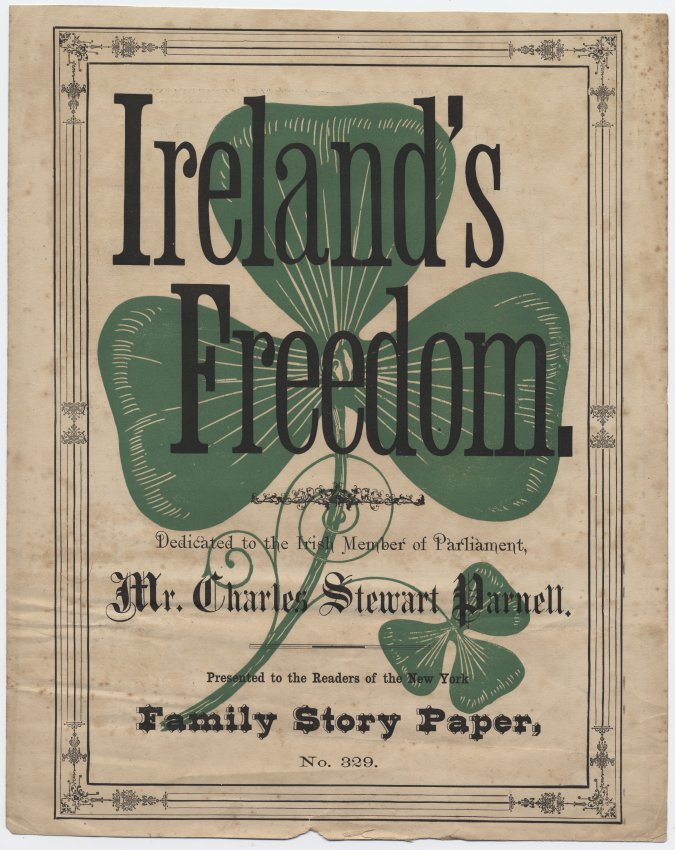
"Ireland's Freedom," 1880 (ECW SL 00-231)
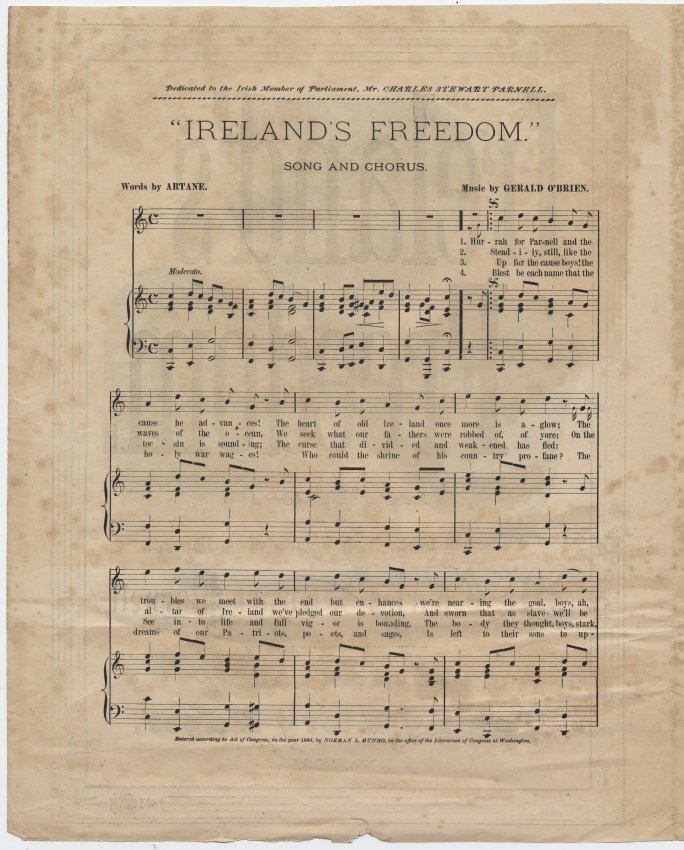
"Ireland's Freedom," 1880 (ECW SL 00-231)
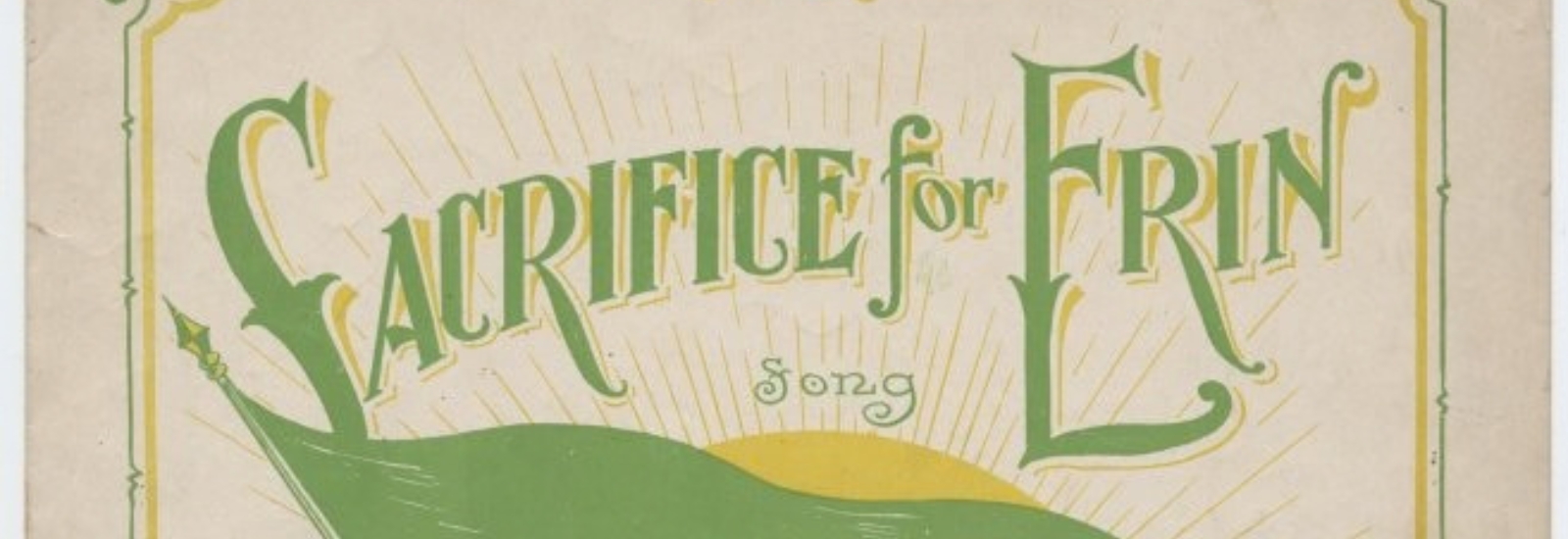
The associated themes of heroism and history in Irish Rebel music are not always separated by multiple decades, however. During the upheaval of revolutionary period from roughly the 1916 Rising to the end of the War of Independence in 1921, when history was being made at a rapid clip, it should come as no surprise that memorialized historical events in Rebel songs occur within a shorter window of time. Thomas O’Dowd’s 1920 Irish Freedom Songbook contains the sheet music and lyrics for “God Save Sinn Fein.” Verses one and two read: “Sweet Erin…striving for liberty…tear Britain’s bloody hand from our dear motherland” and “on that Eastertide ‘mid’ strife and pain your noble martyrs died by England slain, when hopes that were once high, in quicklime there did lie.” Again, the theme of heroic sacrifice (“noble martyrs died” for “Sweet Erin”) is linked to a significant historical event in Irish history- the “Eastertide” Rising of 1916 and the infamous execution of its leaders “by England” and their unceremonious entombment “in quicklime.” Similar themes and references appear in Bert Rourke’s 1916 song, aptly named, “Sacrifice for Erin.” Various lines from the song read: “he fought against odds disregarding the cost…for his rights and for Ireland’s freedom…gave up his life like a hero so brave.” The final verse reads: “a court-martial trial was all that they gave him…just after midnight…the firing squad it took aim…a roar shook the earth as his spirit departed.” Once more, the theme and memorialization of the unjust court-martial/execution appear linked to the ideal of “Ireland’s freedom.”
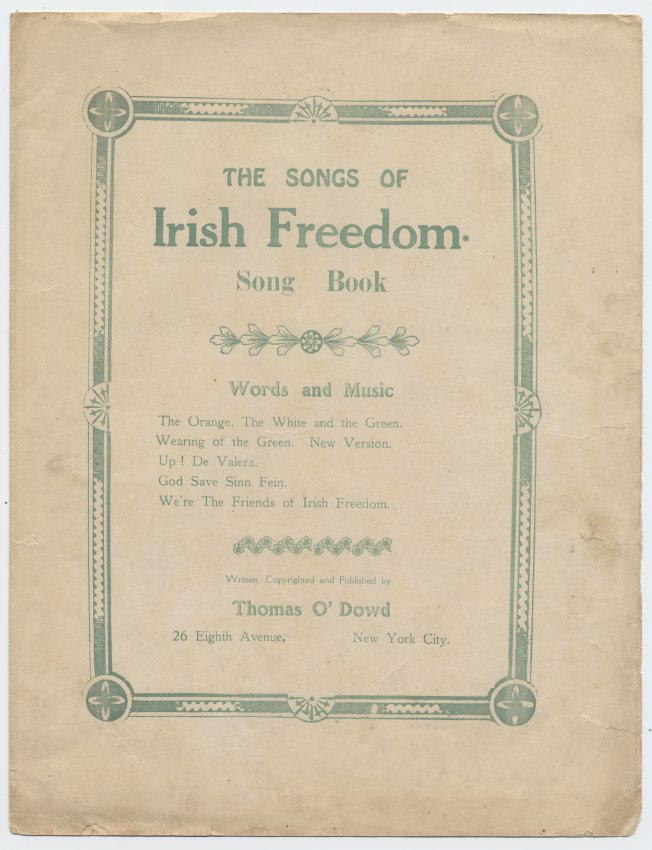
The Songs of Irish Freedom, 1920 (IF SL 03-490)
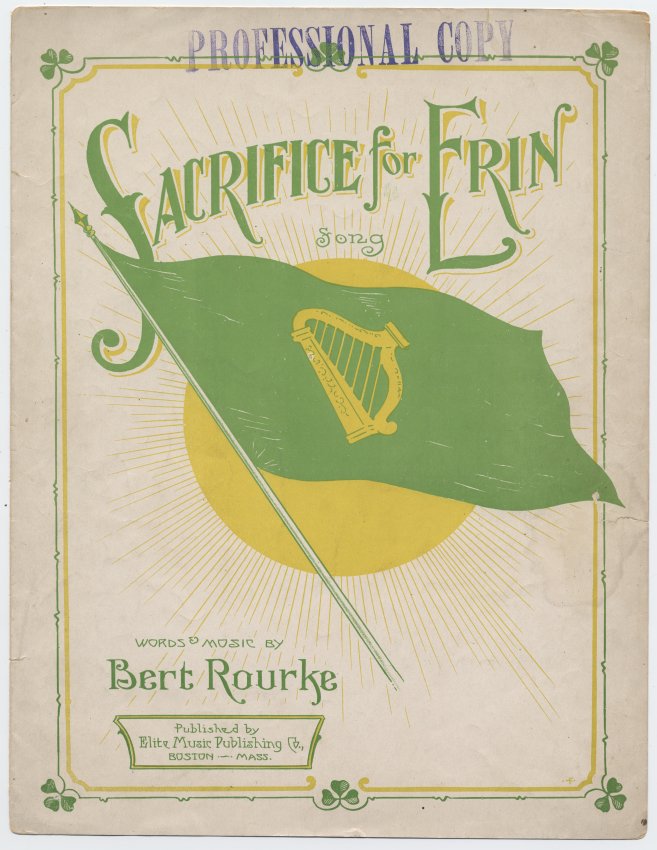
"Sacrifice for Erin," 1916 (IF SL 01-515)
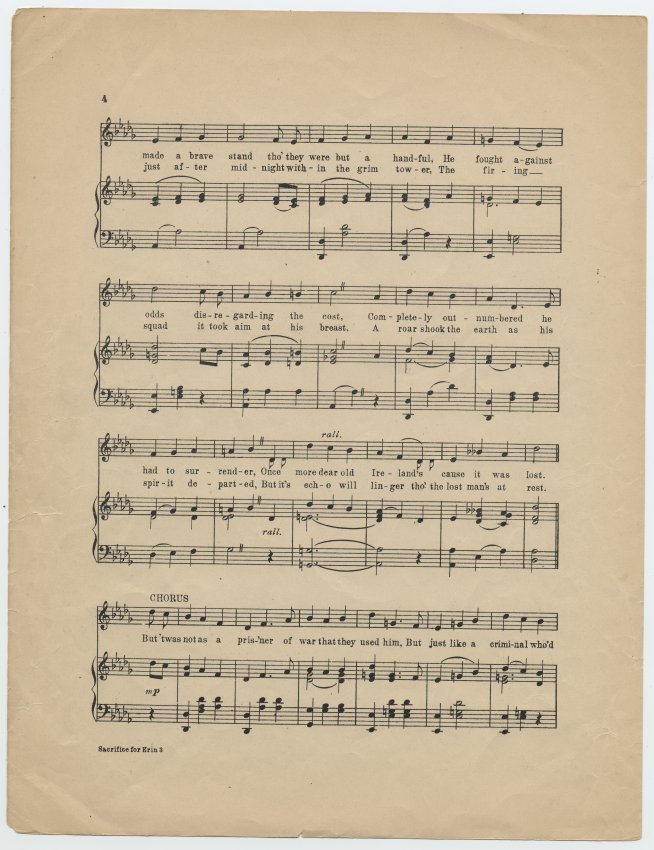
"Sacrifice for Erin," 1916 (IF SL 01-515)
What is, perhaps, most fascinating about the Irish Rebel music is how these ghostly themes continue to be summoned by musicians into the present. Anyone with even a passing familiarity with contemporary Irish Rebel music has likely heard of The Wolf Tones and their respective artists’ various solo or splinter musical projects. As late as their 2011 album Child of Destiny, The Wolfe Tones included the song “Who Fears to Speak of ’98.” The song, originally composed in 1843 by John Kells Ingram under the name “The Memory of the Dead,” commemorates “the brave, the faithful, and the few” who rebelled and died in the United Irishmen rebellion of 1798 alongside their leader- and namesake of the band- Theobold Wolfe Tone. Another, even more contemporary example, of heroism and history in Irish Rebel music is the band Flogging Molly’s 2022 song “A Song of Liberty.” The song is an upbeat recounting of the events leading up to, during, and immediately after the 1916 Easter Rising. In addition to including a chorus in which each name of the seven leaders of the Rising are invoked and a verse referring to their executions as an event which “free[d] our souls,” the song solemnly concludes with a spoken-word section quoted directly from The Proclamation of the Irish Republic: “by its valor and discipline and by the readiness of its children to sacrifice themselves for the common good.”
Although the Ward Irish Music Archive (WIMA) is not, strictly speaking, a repository of “Irish Rebel music,” the vastness of its Irish (and increasingly pan-Celtic) musical collection lent this historian’s niche interest to be more than satiated. Their collection of nineteenth and early twentieth century sheet music and songbook collections are a rich and invaluable primary source for anyone interested in Irish music (and Romantic poetics) of the periods discussed above. Scarcely a word in the above article would have been possible without it- and there is much left that could be written. This brief foray into a smaller Rebel-focused subsection of WIMA’s collection is just one of innumerable paths of archival inquiry. Their collection of sheet music, vinyl LPs, and CDs offer insights into the history of the Irish diaspora, the Americanization of the Irish/the ‘Irishization’ of America, and changes in how Ireland and Irishness were, and continue to be, constructed and negotiated- all through various musical mediums. Though music and poetics are sometimes assumed to be outside the purview of “History” as a discipline, they remain indispensable in understanding, at least in part, historical actors’ views and beliefs- what’s going on ‘in their heads.’ Irish Rebel music pursues what historian Eelco Runia has termed “Presence.” The universally human desire to be “in touch with people, things, events, and feelings that made you into the person you are” born out of “the determination to account for the fact that our past- though irredeemably gone- may feel more real than the world we inhabit.”