
Burl Ives (1909-1995)
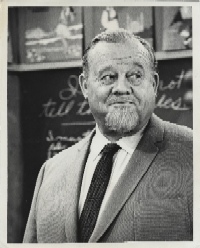 With a name like Burl Icle Ivanhoe Ives it may seem surprising to many that his name would be celebrated in an Irish music archives. Like many genealogists know, names often only reflect the paternal side of a person. Burl Ives always gave credit to his grandmother for giving him his start as a singer. Both of his grandmothers were Irish with his maternal grandmother being an O'Flynn before marriage and his paternal grandmother a White. Burl states that "I am fortunate both carried with them, and gave me as a little boy, many of the beautiful songs which I know now are of Irish derivation."
Burl was born in Hunt, Illinois on June 14, 1909. He was the son of tenant farmers in the "Bible Belt" of Illinois and was singing publicly by the age of four. His grandmother Kate White was one of his greatest influences during these early days. Burl would stroll over to his grandmother's house after his grandfather, Cyrus White would go into the fields to work. Cyrus was a God-fearing man that didn't drink or smoke and felt that any singing should only be done in praise of the Lord. But when Cyrus left the house Kate would light up her pipe and occasionally chew tobacco while she taught Burl all the old folk songs she knew and loved.
Burl was a quick study when it came to music and soon he was singing at church functions and community functions. He went to school at Eastern Illinois State Teachers College from 1927-29 before leaving. He travelled throughout the United States for the next two years and learned many more folk songs. He then went to Juilliard in New York where he began singing professionally. He then spent many years in Broadway productions and was also a performer on the radio as a soloist and as part of the popular folk group "The Weavers." His folk singing persona during his radio and concert performances was known as "The Wayfaring Stranger."
During the 1950's and 1960's Burl appeared regularly on TV and radio and toured America promoting American folk music. He was very successful in film and played the role of Big Daddy in Tennessee Williams "Cat On a Hot Tin Roof." He won an Oscar for his performance in the film, "The Big Country."
Burl is also remembered every Christmas as the narrator for the classic animation film of "Rudolph, The Red-Nosed Reindeer."
He toured Ireland in 1952 and 1953. Upon returning from these tours he put together an album of Irish Songs. During production of this album Burl wanted to research more Irish songs and found that there was very few Irish folk songs published in the states so he published his own book of Irish songs in 1955.
In his Irish album "Songs of Ireland" he states:
Many of the songs I learned in my boyhood were almost unchanged from the originals, but it was not until I visited Ireland that I felt them as part of the Irish countryside and Irish life of the past and present. Indeed, an Irish song in its homeland is a thing of even greater beauty. …Whatever it is that makes the quality of a land and the temperament of a people was so akin to me that I recognized immediately a home for my spirit.
In 1948 Burl recorded "Blue Tail Fly" with the Andrews Sisters and it become one of his signature songs. In 1962 he had four more songs in the top forty, two of them "A Little Bitty Tear," and "Funny Way of Laughing" entered the top ten. He recorded into the 1970's and in 1979 he retired to his home in Washington State where he died in 1995.
Burl Ives was on the front line of folk music his entire life. He was a gentle giant. His performances were spirited and through his diverse talents he became one of America's best-loved entertainers. His presence on the musical scene not only served to sustain an awareness of neglected American folk songs, but would contribute to the resurgence of interest in folk music that occurred in the early 1960's.